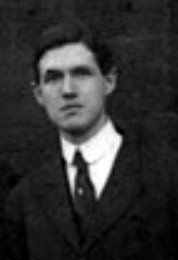
(Photo courtesy of the Eastern Kentucky University Special Collections and Archives, Richmond KY)
Hometown: Lexington, KY (Dudley School)
Playing Height: 6-0
Date of Birth: March 13, 1887
Date of Death: May 9, 1962
Additional Photos: (1)
| Season | Games Played | Statistics |
|---|---|---|
| 1903-04 | - | Insufficient Data |
| Total | Insufficient Data |
Obituary - Roark, Dr. Ruric Creegan, Washington Post (May 11, 1962)
On Wednesday, May 9, 1962, at his residence, 3163 Adams Mill Rd. NW., Dr. Ruric Creegan Roark, beloved husband of Anna Brown Roark; brother of Raymond J. Roark of Madison, Wis., and Miss Mary Kathleen Roark. He is also survived by a niece and two nephews.
Friends may call at the S.H. Hines Co. Funeral Home, 2901 14th St. NW. (parking facilities).
Services at the time above funeral home on Friday, May 11, at 2 p.m. Interment Canton, Pa.
Semi-Centennial Alumni Record of the University of Illinois by University of Illinois, Frank William Scott (1918)
G569 RURIC CREEGAN ROARK
(Brother of No. 4875)
Chemist; A.M. 1908; b. Mr. 13, 1887, Glasgow, Ky.; s. Ruric Nevel (b. 185, Greenville, Ky.) and Mary (Creegan) Roark (b. Ia.). Prepared in Lexington (Ky.) H.S.; Ky. St. Univ., 1903-05; Clark Univ., Worcester, Mass., 1905-06. A.B. Univ. of Cincinnati, 1907; Ph. D., George Washington Univ., 1917.
Sigma Xi. Grad. Asst., Organic Chem., Univ. of Ill., 1907-08: Fellow, Chem., Univ. of Wis. 1910-11; Asst. Chem. Bur. of Chem., U.S. Dept. of Agr., 1908-17; Chief Chem., U.S. San. Products Corp., Chicago, 1917 -. Mem. A.C.S. Address, 4738 Kenwood Ave., Chicago; bus. add., 2834 Loomis St., do.
Dr. R.C. Roark Dies in Capital - Canton (PA) Independent-Sentinel May 17, 1962
Noted U.S. Aide in Agriculture
Dr. R. Creegan Roark, aged 75, of Washington D.C., a retired research chemist in the Dept. of Agriculture, died last Wednesday, May 9.
Dr. Roark served 42 years with the United State Agriculture Department spending nearly 30 years in the research division. He won wide recognition for his contributions to the development of fumigants for agricultural products and for his leadership of research on insecticide residues. His work led to the development of many new pesticides.
In 1956 when he retired, Dr. Roark was honored with the USDA's Superior Service Award for "inspirational leadership and meritorious service to agriculture" for developing and improving chemical methods for controlling pests. In July 1927, Dr. Roark was appointed chief of the insecticide division of USDA and his unit was presented with a Distinguished Service Award by the Agriculture Department in 1948.
In addition to his contribution to agriculture, Dr. Roark was responsible for chemical research on insect-control materials important to national defense. In 1946, the surgeon general of the Navy commended Dr. Roark and his staff for exceptional service rendered during World War II.
He was the author of some 200 publications dealing with chemistry and economics of insecticides, and was granted ten United State Patents on new insecticides.
Dr. Roark is survived by his wife, Mrs. Anna Brown Roark, who was formerly of Canton; a brother, Raymond of Madison, Wisc., and a sister, Miss Kathleen Roark of Washington.
Funeral services were held at the S. Hines Co. Funeral Home, Washington D.C., Friday. The remains were brought to the Morse Funeral Home, Canton, Saturday, and interment services were held at 4:00 p.m., in the East Canton cemetery. The Rev. Richard Tillapaugh officiated.
Ruric Creegan Roark (1887-1962) - by Ruth L. Busbey Journal of Economic Entomology Volume 55, Issue 6, December 1, 1962, pp. 1023-1024.
Dr. Ruric Creegan Roark, head of the chemical research on insecticides in the U.S. Department of Agriculture from 1927 to 1956, died suddenly on May 9, 1962, at his home in Washington D.C.
Dr. Roark was born March 13, 1887, in Glasgow, Kentucky. He was the son of Ruric Nevel Roard and Mary Creegan Roark. He attended Kentucky State University, Clark College in Worcester, Massachusetts, and University of Cincinnati, where he received his B.A. degree in 1907. His graduate work was carried out at the University of Illinois (M.A. 1908), University of Wisconsin, and George Washington (Ph.D. 1917). In 1913 he married Anna Brown, who survives him.
In 1908 Dr. Roark entered the U.S. Department of Agriculture as Assistant Chemist in the Laboratory of Vegetable Physiology, Bureau of Chemistry, in Washington, D.C. In 1910 he transferred to the Insecticide and Fungicide Laboratory, which was concerned with enforcement of the Insecticide Act of 1910. During the period 1918 to 1923 he left Federal service for private industry. He was Chief Chemist of the United States Sanitary Specialties Corporation in Chicago from March to October 1918. From November 1918 to March 1923 he was employed as Research Chemist by the General Chemical Company in Baltimore. He returned to the Insecticide and Fungicide Laboratory of U.S.D.A. in 1923 as Associate Chemist. He spent some time in Texas studying repellents for the screw-worm fly. There he was closely associated with Dr. F.C. Bishopp and Dr. E.W. Laake. Later he collaborated with Dr. R.T. Cotton in developing a number of new insect fumigants including ethylene dichloride, ethylene oxide, and the formates. Millions of pounds of these fumigants were used for destroying insects in grain, flour, packaged cereals, dried fruits, nuts and tobacco. Dr. Roark and Dr. Cotton received a Modern Pioneer Award from the National Association of Manufacturers in 1940 for this development.
The Insecticide Division of the Bureau of Chemistry and Soils was established in July 1927 and Dr. Roark was appointed chief. He remained in charge of the research of this group, throughout various reorganizations and renamings of units within the Department, until he retired in 1956. The Division was transferred to the Bureau of Entomology and Plant Quarantine in 1934 and is now the Pesticide Chemicals Research Branch of the Entomology Research Division. This was a period when interest in new, more effective, and safer insecticides began to burgeon and his farsighted leadership brought the group into early prominence in this field. Under his direction many outstanding contributions were made to the development of new insecticides, improvements in formulating and applying insecticides, and research on insecticide residues. The group also carried out chemical research on insect control materials important to national defense. In 1946 the Surgeon General of the Navy commended Dr. Roark and his staff for exceptionally meritorious service rendered to naval forces throughout the world during World War II. In 1948 the Department of Agriculture presented a Distinguished Service Award to this group, and in 1956 Dr. Roark was personally honored with a Superior Service Award for "inspirational leadership and meritorious service to agriculture in developing and improving the use of chemical control methods for insect pests."
Dr. Roark played a major part in the development and widespread adoption of the rotenone-containing insecticides derived from derris cube, and related plants. He pioneered in the search for synthetic organic compounds and insecticides derived from plants to replace the toxic aresenicals that formerly were the chief insect control chemicals. He also was a leader in recognizing the....